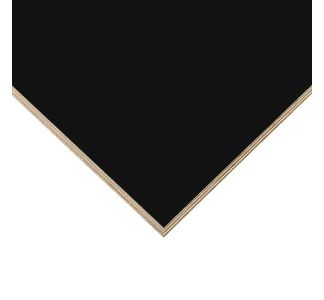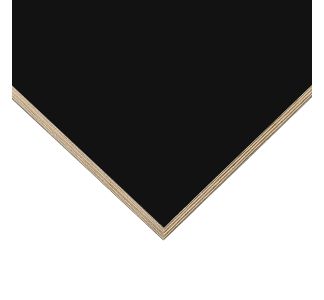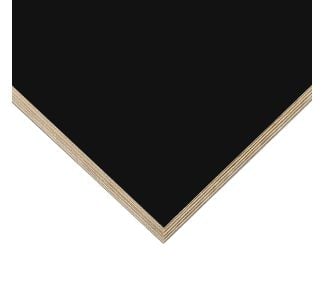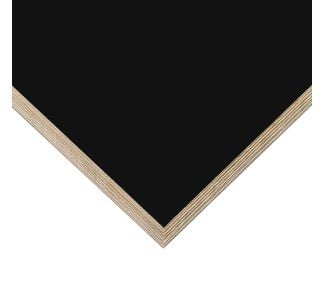


View our full range of products
including made to order items
A New Shopping Experience!
Select ‘Full Catalogue’ to view our full catalogue including items subject to custom manufacturing, POA and longer lead times.
Select ‘Buy Online’ to view all products available to purchase online today.
Everything you need to know about our film faced birch plywood, from finishes and thicknesses to cutting, fixing and compliance. If you cannot find an answer here, or need documented technical information for a specific project, please get in touch and our team will help.
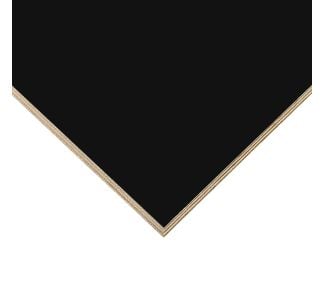
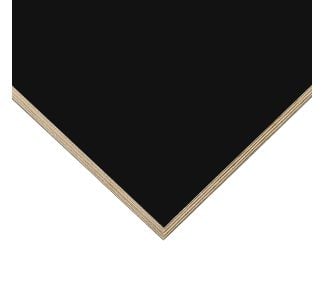
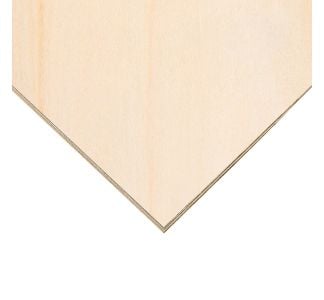
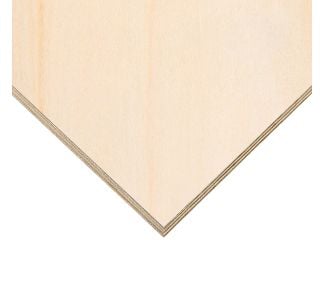
Film faced plywood is birch plywood with a phenolic film bonded to the surface under heat and pressure. The film is the hard, water-resistant, wipe-clean layer, and the birch core underneath does the structural work. Our M-Series carries a 185gsm phenolic film over cross-bonded birch veneer, bonded with phenol-formaldehyde resin. The X-Series carries a lighter 120gsm film.
Yes. Phenolic plywood, film faced plywood and phenolic-faced birch all describe a plywood panel with a phenolic surface. Film faced means a separate phenolic film is bonded to the face, which is exactly what these panels have.
No, they are built for different jobs. Marine plywood is a solid plywood graded for prolonged water exposure and boat building, with a high-grade void-free core and a water-resistant bond, but no surface film. Film faced plywood uses a similar exterior-grade bond and adds a hard phenolic film to the face, giving it abrasion resistance and a wipe-clean surface. For flight cases and touring builds you want that tough, sealed face, which is why film faced birch is the standard choice. Neither board is fully waterproof once you cut or drill it, so exposed edges still need sealing.
No. The phenolic film is water-resistant and repels water well, but it only covers the faces. The moment you cut, drill or rout the sheet you expose raw birch core, which will absorb water.
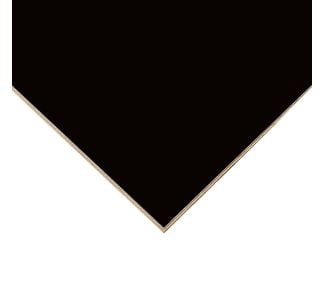
Seal them. Factory edges arrive sealed with black paint, and on a finished case most of those edges end up inside the extrusion anyway. The edges that matter are the ones you create: dividers, shelves, lid returns, cable pass-throughs, and holes drilled for handles, latches and castors. Our speaker paint works well for this. Leave them bare and water can seep into the core, which can swell and delaminate over time.
The film is bonded with phenol-formaldehyde resin under heat and pressure rather than glued on, so it does not lift or peel with normal use. These panels are built for the wear, handling and demands that touring places on a flight case.
The M-Series comes in 2440 x 1220mm sheets with a 185gsm film, manufactured to EN 13986 and EN 314-3, formaldehyde class E1 with CARB Phase 2, and FSC Mix 96%, available in a selection of finishes and colours.
The X-Series comes in larger 2500 x 1250mm sheets with a 120gsm film and a BB/BB face grade, available in brown as well as black.
If your project needs documented compliance, or you cannot find specific technical information on the individual product pages, please contact us.
Every product page lists both faces separately, so check the listing if you are unsure.
Contact us with the finish and thickness you need and we can advise.
The M-Series is supplied in 2440 x 1220mm sheets and the X-Series in 2500 x 1250mm sheets. The table below sets out the range by finish.
| Finish | Series | Face | Reverse | Thicknesses | Sheet Size |
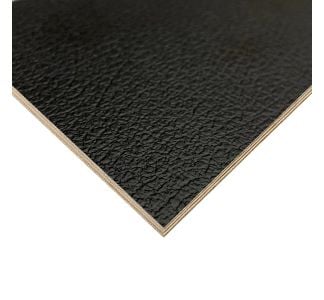
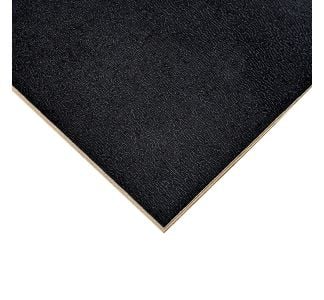
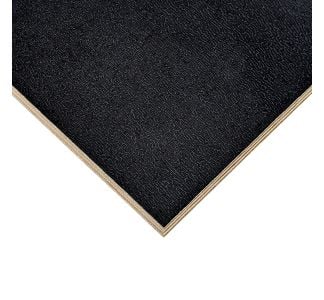
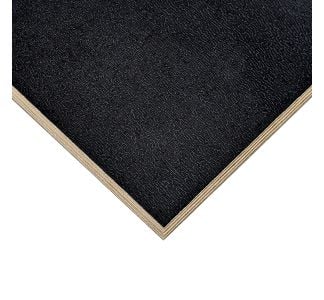
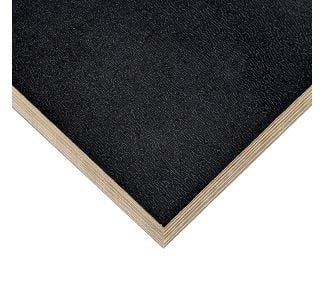
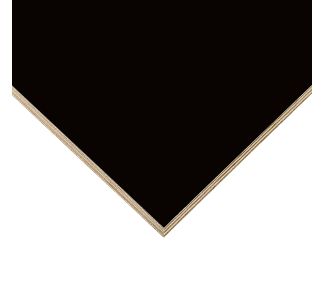
| Smooth | M845 | Smooth black | Smooth black | 9.5, 12, 15, 18mm | 2440 x 1220mm |
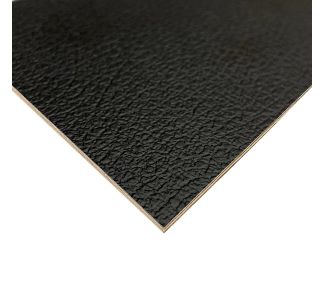
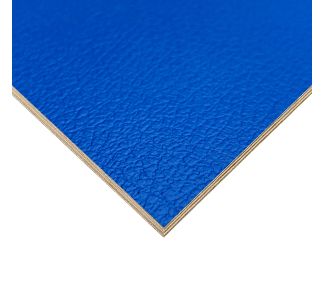
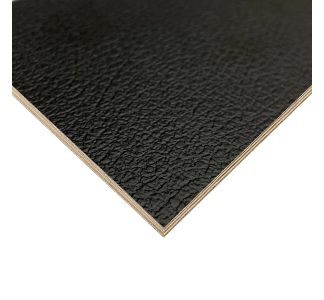
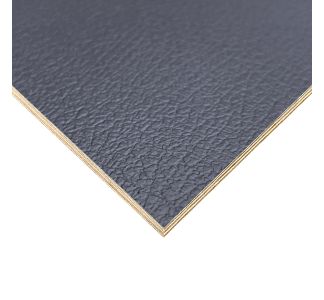
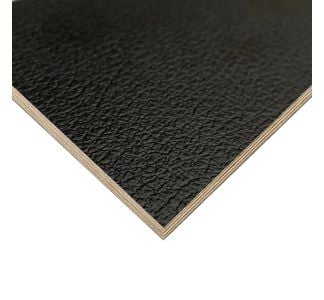
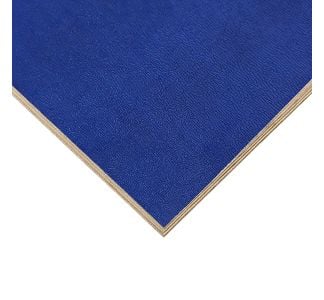
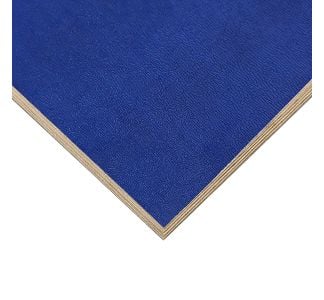
| Textured | M846 | Textured black, blue or grey | Smooth | 6.5, 9.5, 12mm | 2440 x 1220mm |
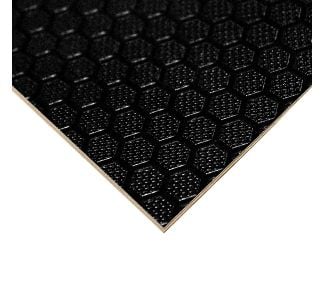
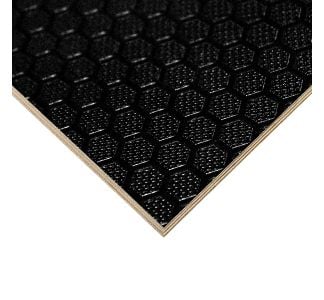
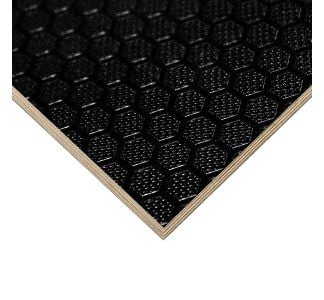
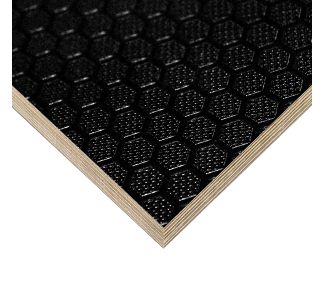
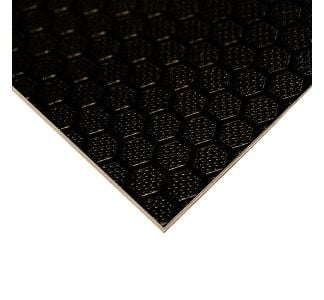
| Hexa | M847 | Hexa black or blue | Smooth black | 6.5, 9.5, 12, 18mm | 2440 x 1220mm |
| Haircell | M852 | Haircell black or blue | Smooth black | 6.5, 10.3, 13, 18mm | 2440 x 1220mm |
| Phenolic-backed | M870 | Raw birch | Smooth black | 6.5, 9.5, 12mm | 2440 x 1220mm |
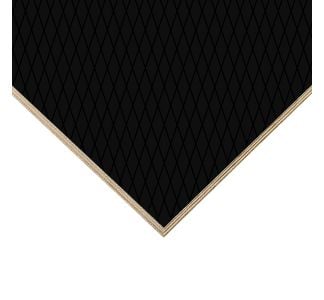
| X-Series | X11 | Smooth, hexa or diamond; black or brown | Smooth | 6.5, 9, 12, 15, 18mm | 2500 x 1250mm |
2440 x 1220mm on the M-Series and 2500 x 1250mm on the X-Series.
Weight depends on thickness. As a guide, a 6.5mm sheet is around 13 to 15kg, a 9.5mm sheet around 19kg, a 12mm sheet around 24kg, and an 18mm sheet around 36kg. Each product page lists the nominal weight for that board. Full sheets are heavy and awkward to move alone, so plan for two people or a trolley when handling them.
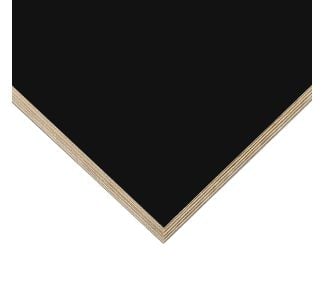
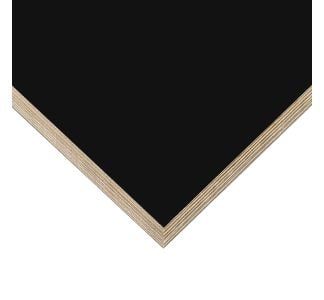
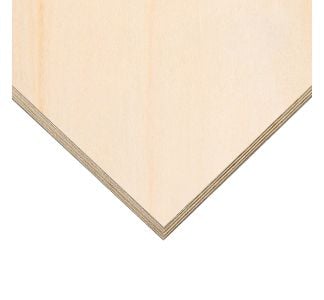
It depends on thickness. A 12mm board runs to around nine layers of cross-bonded birch veneer. Thinner boards have fewer, thicker boards more, with a minimum of five across our range. Cross-bonding the layers at right angles is what gives the panel strength and stability in both directions.
Yes. The birch core is void free, which also helps it hold screws/fixings and machine cleanly at an edge.
Most of the range is held to +0 / -0.5mm, meaning a board measures at or fractionally under its nominal thickness, but never over. The 15mm and 18mm Smooth boards are held to +0.4 / -0.4mm. This matters when you slot a panel into the extrusion: an undersized board always fits, an oversized one may not.
We do not publish one. Film faced birch plywood is generally very stable, but flatness after delivery depends on how the sheets are stored. We recommend storing them flat and well supported rather than leaning. If flatness is critical to your build, get in touch and we can share storage advice and best practices.
9.5mm to 12mm suits most 19" rack cases and flight cases. 9.5mm is the common all-round choice, strong enough for a touring shell without carrying unnecessary weight. 12mm steps up strength for larger or heavier cases. 6.5mm suits lids, lightweight cases and interior work. 15mm and 18mm are usually reserved for bases and decks rather than case walls.
Each extrusion listing carries a schematic drawing showing the opening width for the panel board. Match the board to that opening, and allow for any laminate or covering you are adding on top. As an example, an extrusion with a 9.6mm opening takes our 9.5mm board.
Which extrusion you need depends on the case. Filter our extrusion range by board thickness, plan your build in Case Designer, or contact our team who can help with project specifications.
Yes. Get in touch and we will sort a sample so you can check the finish, colour and thickness before committing to full sheets.
Panels ship as full sheets on a pallet. We can accommodate certain cuts on request, though this depends on your location and may carry a fee. Contact us directly to find out more.
Yes. Standard saws, routers and drills all work, and a good circular saw will cut it cleanly in experienced hands. We recommend:
Always wear a dust mask and run extraction.
Rivets, screws and bolts all work, using the same rivets you would use on standard plywood provided they suit the panel thickness. Drill pilot holes, particularly near edges, to stop the core splitting, and countersink so heads sit flush. For anything carrying load, such as handles, latches and castors, fix through a batten into the extrusion rather than relying on the face of a thin panel alone. Seal any hole that will be exposed to moisture.
Not easily. The phenolic surface is smooth, so ordinary paints struggle to key to it. If you must paint it, abrade the surface, clean it thoroughly, use a compatible primer, and test on an offcut first. If you want a paintable face, the phenolic-backed M870 panel gives you raw birch on show and a sealed phenolic face hidden.
Yes. Some of our customers screenprint directly onto these panels, and vinyl and stickers apply to the film without trouble. Screenprinting holds up better than spray paint on this surface, so it is worth considering if you need durable case markings.
Yes. Our M6900 spray adhesive is made for bonding carpet and foam, and the M6905 is a lamination spray for sheet laminates. Follow the instructions and black out the edges and corners first so no pale core shows through.
It solves a specific problem: you want a sealed, protected hidden face but a workable face on show. One side is raw birch you can paint, laminate or veneer, and the other is smooth black phenolic. It suits case interiors and any panel getting a decorative finish.
The Hexa finish presses a hexagonal pattern into the phenolic face to give grip. We do not have a published slip rating. If your project needs a test value, please contact us.
The phenolic film wipes clean with water or a mild detergent. Avoid dragging abrasive materials across it, and do not leave water sitting on unsealed edges. The film resists UV degradation, but colour may fade under long-term direct sunlight.
Yes. The M-Series is FSC Mix 96%, meaning the panel is produced under FSC chain of custody from a mix of certified, recycled and controlled sources.
The M-Series is manufactured to EN 13986 and EN 314-3, is formaldehyde class E1 with CARB Phase 2 compliance, and is FSC Mix 96%.
In brief: EN 13986 is the European standard for wood-based panels used in construction, EN 314-3 is the top bonding class for exterior conditions, E1 caps formaldehyde emissions at a low level suitable for indoor use, and CARB Phase 2 is the Californian low-formaldehyde standard that is widely recognised elsewhere.
EN 314 grades the bond between the veneer layers by moisture resistance and exterior conditions, with Class 3 the top grade. It describes the internal glue bond, not the surface. That is why you still need to seal cut edges: the bond will hold, but exposed core will still absorb water.
No. These panels are not manufactured to be fireproof or fire-retardant, and we do not publish a fire classification for them. If your venue, tour or installation has a fire performance requirement, contact us and our team can advise.
These panels have not been tested or certified to ISPM-15. ISPM-15 generally exempts manufactured wood-based panels such as plywood, because the manufacturing process involves heat and adhesives. If you are building crates for export, confirm the requirements with your freight forwarder or speak to us first.
We cannot recommend their effectiveness outside their intended use. Some customers have used these panels for similar applications, as cross-bonded birch is strong in both directions, the Hexa face gives grip, and the phenolic surface handles abrasion. The primary use for these panels is flight cases and similar builds, not vehicle bodies or furniture.
sgm_clp_1 div for segmentify