

View our full range of products
including made to order items
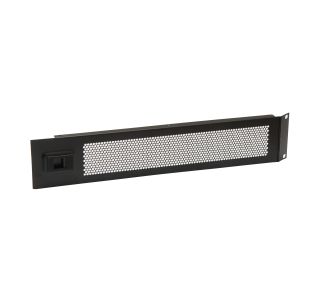
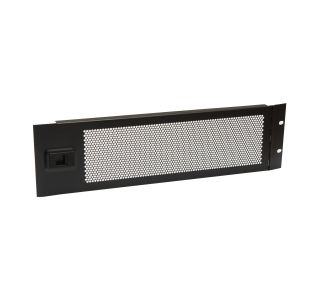
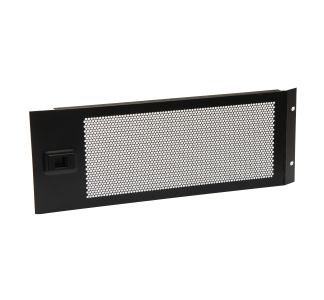
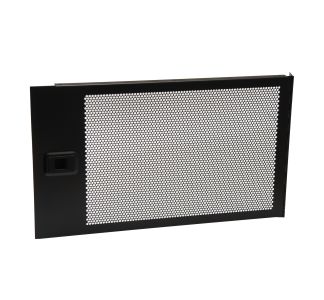
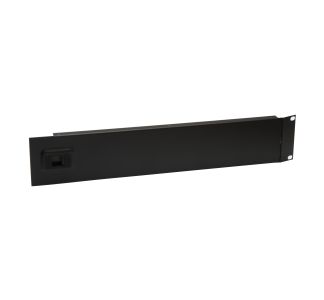
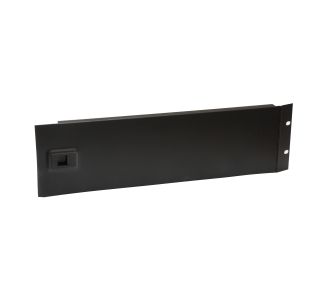
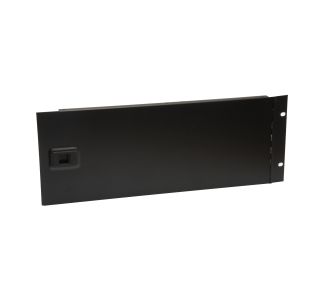
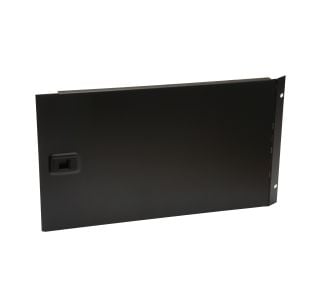
Explore Penn Elcom's range of rack doors and hinged panels manufactured to enhance the functionality, security, and airflow of your 19″ rack. Designed for professional audio, video, networking, and IT installations, our range includes perforated doors for ventilation, solid doors for security, and hinged panels for easy access to equipment.
A New Shopping Experience!
Select ‘Full Catalogue’ to view our full catalogue including items subject to custom manufacturing, POA and longer lead times.
Select ‘Buy Online’ to view all products available to purchase online today.
Crafted from high-quality materials, these innovative rack doors provide protection, efficient airflow, and convenient accessibility while optimising your rack organisation. Explore our selection to find the right rack door solutions to secure and elevate your 19″ rack setup.
A rack door is a hinged or removable steel front that mounts to the vertical rails of a 19-inch rack and covers a section of the rack face. It gives you access to the equipment behind it while keeping the front tidy and, on a locking version, secure.
Three terms are often used interchangeably, so it helps to separate them:
If you have an enclosed cabinet and need a replacement full-height door, contact us and we can advise.
Both cover a section of the rack front, but they fit and behave differently.
Choose a hinged panel for quick, tool-free access to a clear section of rack. Choose a removable door where equipment is already mounted behind the opening, where you need a key lock, or where there is no room to swing a door open.
Choose a vented (perforated) door if there is any heat-generating equipment behind it. Choose a solid door for a clean, uniform rack front, or where the equipment behind runs cool.
Heat can build up quickly behind a solid front in a closed or poorly ventilated rack, and it is easy to underestimate. If you are unsure, a vented door is the safer option: it improves airflow at no cost to appearance.
It depends on the thickness of your rack strip, the vertical mounting rail.
If you are ordering a rack and door together, this is a one-time decision. If you are retrofitting to an existing rack, measure the rail thickness first.
Measure across the flange with a vernier or digital caliper, not at a fixing hole. If you do not have calipers, identify the rack strip part number and check it against our rack strips and rails, or the single rack rails if yours is a single strip rather than a double.
If the rack came from another manufacturer with no part number to work from, measure it. Rail thickness is the most common reason a hinged panel does not fit, and the check takes two minutes. If you are unsure, contact us with the relevant information and we can advise.
It will close, but not tightly. The slam lock is sized for a set range of material thickness. On a thinner rail it still engages, but with free play, so the panel can rattle rather than sit firm. That may be acceptable on a fixed installation. On anything that moves, such as a touring rack or flight case, it might not be.
Packing the rail out is a workaround rather than a reliable fix, and we would not recommend it for equipment that travels. If your rails are thinner than 1.5mm, the R1298 removable door is the better answer, because its fit does not depend on rail thickness.
Not in most cases. The slam lock on an R1272 or R1372 has to catch the flange of the opposite rack rail. If a shelf, drawer, or piece of equipment occupies that space, the latch has nothing to close against and the panel will not shut properly.
The exception is a rack with two sets of front rails: mount the equipment to the rear pair and the panel to the front pair. To cover equipment that is already mounted, use a removable door such as the R1298-6UK instead. It fixes to a frame rather than latching into the rail, so what sits behind it does not matter. For anything outside the standard range, our custom metal service can help.
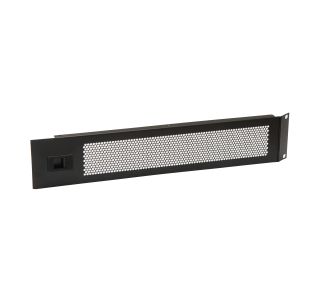
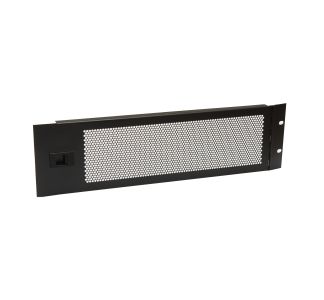
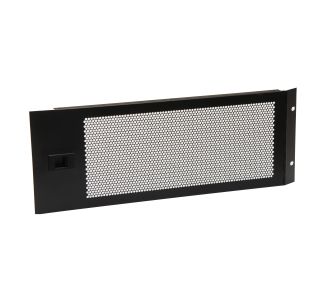
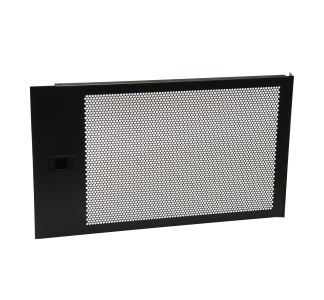
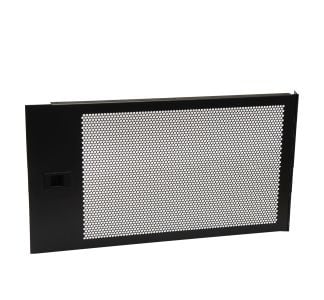
The vented versions across the R1272 and R1372 ranges provide approximately 63% free area, from 3.97mm diameter holes on a 4.76mm staggered pitch.
A vented door helps by letting cool air reach the equipment and allowing warm air to escape, rather than trapping heat behind a solid front. It is one part of good airflow management rather than a complete cooling solution on its own.
For racks under real thermal load, combine a vented door with the usual airflow measures: fill unused rack spaces with blanking panels so hot and cold air do not mix, keep cable runs clear of the vents, and add active cooling such as rack cooling systems and fans where passive airflow is not enough. A solid door is fine where the equipment runs cool, or where directing air along a specific path matters more than open ventilation.
The R1272 and R1372 hinged panels close on a slam lock, also called a slam latch. This is a keyless spring catch that holds the panel shut and keeps the rack front tidy. It is not a security device, and it can be opened by anyone.
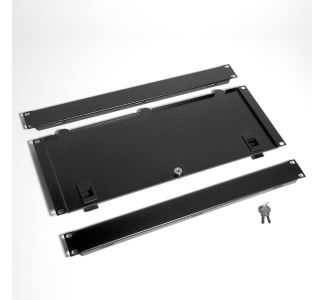
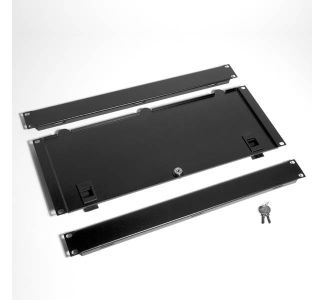
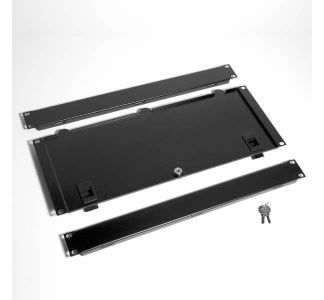
The R1298 removable door is the one to choose for security. It has two slam latches plus a key lock, and the key secures both latches so the door cannot be lifted out once locked. Two keys are supplied. To restrict access to a whole section of the rack, this is the right choice. To secure individual pieces of equipment, see our security panels range.
This applies to the R1298 only, as it is the only door in our range with a key lock. Two keys are supplied as standard, and spares are available separately. For multiple doors keyed alike, contact us with the quantity before ordering. It is not something we can change once the locks have shipped.
A removable R1298 door covers two rack units fewer than its stated size, because the frame occupies 1U at the top and 1U at the bottom. A 6U door fills 6U of rack height and covers 4U of equipment, a 10U door covers 8U, and a 14U door covers 12U. Work this out before ordering: count the rack units you need to cover, add two, and that is the door size to order. You can also use our Rack Unit Calculator for additional help with U size and rack space allocation.
Yes, for the hinged panels. The R1272 and R1372 fit either way round, so the panel can swing from whichever side suits the installation. There are no left-hand or right-hand versions to specify.
The R1298 removable door works differently: it lifts out rather than swinging open, so handing does not apply and there is no swing clearance to allow for.
Fixings are not supplied with doors in this range. What you need depends on your rack strip: square-hole strip takes cage nuts and screws, while tapped strip takes screws alone. The R1272 and R1372 use two fixings per panel, one at the top and one at the bottom.
One common point of confusion: cage nut size refers to the thread, not the rail thickness. M6 and 10-32 are the usual threads. Rail thickness, the 1.5mm, 2mm, and 3mm figures mentioned in these FAQs, determines which door fits, not which cage nut to buy.
Yes. The slam lock is available separately.
Yes. 3D models for the range are under “Technical Information” on individual product pages, and 2D drawings are shown in the image carousel for each product. If you need a format that is not listed, or a drawing for a product is missing, please contact us.
For anything outside the standard range, our custom manufacturing and metal fabrication service can produce bespoke doors and panels. Contact our team with your requirements and we can quote for lead time and cost.
sgm_clp_1 div for segmentify