

Rack Drawers
Upgrade storage and organisation with Penn Elcom’s rack drawers, designed for professional audio, video, and IT applications. Our range includes standard rack drawers, laptop drawers, and lockable options, providing secure, accessible storage for valuable equipment.

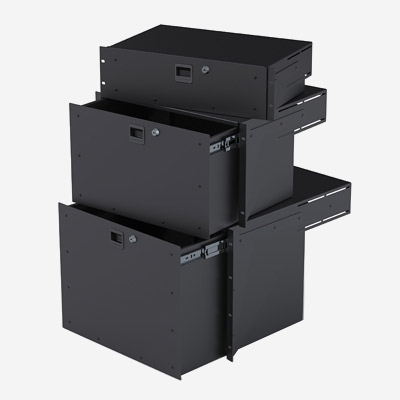
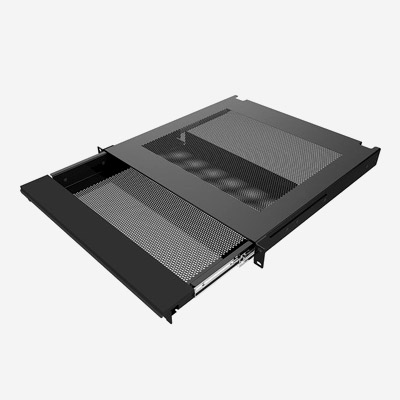
Crafted for repeated, long-term use, our drawers are available in various U sizes and built to suit heavy-duty, tour-grade, and lightweight systems. Penn Elcom rack drawers help streamline workflows, reduce clutter, and enhance efficiency, making them an essential addition to any 19″ rack setup. Explore our selection to find the perfect rack drawers for your installation.
Rack Drawers Frequently Asked Questions
Rack drawer basics
What is a 19 inch rack drawer, and how does it work?
A 19 inch rack drawer is a sliding storage unit that mounts into a standard 19 inch equipment rack, fixing to the same vertical rails as your other rack-mount gear. It sits within the rack footprint and pulls out on runners so you can reach the contents, then slides back flush when not in use. Height is measured in rack units (U), the same measurement used for every rack component, where one U equals 44.45mm (1.75 inches). Because the drawer is enclosed, it keeps smaller items contained and protected rather than loose on a shelf or around the setup.
What can you store in a rack drawer?
Rack drawers are designed for the items that support a system but do not need to be permanently wired in, such as cables, adapters, connectors, tools, spares, batteries, documentation and smaller devices. In audio, video, networking and IT environments they keep consumables and accessories with the rack they belong to, so nothing goes missing between jobs or between sites. Lockable versions extend this to valuable or sensitive equipment such as laptops, radio microphones, test instruments and control surfaces, where controlled access matters. Keeping these items in a drawer also protects them from dust and knocks compared with open storage.
What is the difference between a rack drawer and a rack shelf?
A rack shelf is an open platform that equipment sits on top of, giving quick access and good airflow for devices that stay in place. A rack drawer is enclosed and slides out, which suits loose items, consumables and anything you want kept out of sight or secured behind a lock. Many racks use both: shelves for devices that need to be seen, connected and ventilated, and drawers for the accessories, tools and valuables that support them. If security or containment matters, a drawer is the better option.
Choosing the right rack drawer
How do I choose the right U height?
Start with the tallest item you need to store, then allow a little clearance above it so the drawer opens and closes freely. Convert that to rack units, remembering each U is 44.45mm and that the usable internal height is slightly less than the nominal U figure once the drawer’s own base and frame are taken into account. Then check that height against the free space in your rack, since the drawer occupies that U space permanently. As a general guide, a 2U drawer suits cables, tools and small accessories, while taller 4U and above options give room for bulkier items or a greater volume of stock. The Rack Unit Calculator helps you confirm the available U before you order.
How do I choose the right depth?
Depth is as important as height and is where drawers are most often ordered incorrectly. Measure your items front to back, then make sure the drawer depth suits both the contents and the internal depth of your rack or cabinet, allowing room for the front door to close and for the drawer to slide out without catching anything at the rear. A drawer that is too deep for the rack will not seat correctly, while one that is too shallow wastes usable space. Penn Elcom standard drawers are offered in several depths, to suit shallow wall cabinets through to full-depth floor-standing racks, so you can match the drawer to the enclosure.
What is the difference between standard, lightweight and laptop drawers?
Standard rack drawers are the general-purpose choice, built from steel for strength and long service in both fixed installations and racks that move regularly. Lightweight drawers are made from aluminium to reduce weight, which is valuable in touring and portable systems where the total load of a flight-cased rack adds up quickly. Laptop drawers are shaped and secured specifically for laptops and similar devices, giving safe, lockable storage for a single high-value item.
Should I choose a steel or aluminium drawer?
The decision usually comes down to weight against strength. Steel drawers offer maximum durability and suit heavier contents, demanding environments and permanent installations where the rack rarely moves. Aluminium drawers weigh significantly less, which makes them easier to handle and reduces the overall weight of a mobile or flight-cased rack that is loaded, transported and rigged repeatedly. Both are built for repeated, long-term use, so the choice is guided by how the rack is used rather than by quality or strength. Recommended load capacity is also listed on each product page.
Will a rack drawer fit my rack, and how is it installed?
Penn Elcom rack drawers are made to the 19 inch standard, so they fit standard racks, cabinets and enclosures and mount to the vertical rails at the front. Before ordering, confirm three things: that you have enough free U space for the drawer height, that the drawer depth suits your rack’s internal depth, and that the front door has clearance to close. Installation follows the same principle as any rack-mount item, fixing to the rails, with deeper or heavier drawers additionally supported on their runners. If you are fitting into an existing populated rack, plan the drawer’s position so it can open without obstructing the equipment above or below it.
Security & Use
Are rack drawers lockable and secure?
Many Penn Elcom rack drawers are lockable, which keeps contents both out of sight and access-controlled within the rack. This is particularly useful in shared, public or multi-user environments, and in touring, where a rack passes through many hands between the truck and the stage. A lock also deters removal of high-value items such as laptops and radio equipment. Locking arrangements vary across the range, so check the individual product to find the model that fits your security needs.
How much can a rack drawer hold, and how should I load it?
Load capacity depends on the specific drawer, its size and its construction, so check the individual product for the rated figure before storing heavy items. Whatever the rating, a few loading principles protect both the drawer and the rack: keep heavier items low and towards the centre, distribute weight evenly rather than loading one side, and avoid leaving a fully extended drawer heavily laden, as an open drawer places more leverage on the runners and rails. Staying within the rated capacity is the single most important factor in smooth operation and long service life. If you have any questions, contact our team.
Are rack drawers suitable for touring and mobile setups?
Yes, and they are widely used for exactly this. In a touring or flight-cased rack, drawers stop cables, tools and accessories from moving around in transit and keep everything with the system it belongs to. Aluminium lightweight drawers are the usual choice where weight is a concern, since they reduce the load that has to be lifted and transported, while steel drawers are chosen where durability is the priority. Lockable options add a layer of security for gear that is repeatedly moved through public and backstage spaces.
Fitting & Support
Do I need to support a rack drawer from the rear, or is front fixing enough?
For lighter contents such as cables, tools and small accessories, fixing to the front rails is enough. Once a drawer is heavily loaded, and particularly once the rack is transported, the front fixings and the drawer frame carry considerable leverage every time the rack moves. In that situation, support the drawer from the rear as well, either on rear rails, on runners, or by seating it directly on the equipment or drawer below it. A loaded drawer in a mobile rack puts far more force through four front screws than the same drawer standing still in a fixed installation, so plan the support around how the rack is used, not just what the drawer holds.
Why does my rack drawer stick, sit crooked or come off its runners?
Almost always this is a fitting issue rather than a fault with the drawer. Check that the vertical rails are parallel and at the correct spacing, as rails that have shifted or been drilled out to a non-standard thread will hold the drawer out of square. Confirm the drawer is level in the aperture before tightening, that all fixings are engaged, and that the screws are firm but not overtightened, since overtightening can pull the faceplate and distort the frame. Also check the drawer has clearance at the rear of the rack so it is not catching on cables or on equipment behind it.
Where in the rack should I fit a rack drawer?
Fit heavier drawers as low in the rack as the design allows, which keeps the centre of gravity down and improves stability, especially in a mobile or castored rack. Two things limit how low you can go. In a flight case with an inset lid or a castor board, the bottom few inches of the rack can be obstructed once the case is assembled, so a drawer mounted at the very base may not be accessible at a show. Second, allow the drawer to open without fouling the front faces, handles or connectors of the equipment directly above and below it.
Rack compatibility
Do I need to leave ventilation space around a rack drawer?
A rack drawer is enclosed and generates no heat of its own, so it does not need clearance for its own sake. What matters is the equipment around it. Amplifiers, servers and power supplies that draw air from the front or vent from the top may need free U space, and a solid drawer faceplate directly above or below such a unit can restrict that airflow. Check the ventilation requirements of the heat-generating equipment in the rack first, then position the drawer where it will not obstruct an intake or an outlet. Where no clearance is required, stacking the drawer directly on the unit below also gives it useful additional support.
Storage & Accessories
How do I store items that are not 19 inch, such as routers, tablets and half-rack units?
Plenty of equipment that belongs in a rack was never built to mount in one. Small network devices, tablets, control interfaces and half-rack units are typically handled in one of three ways. A rack shelf holds a device in place with access and airflow. A drawer keeps it contained and, in lockable versions, secured. Rack panels and blanking plates close the remaining aperture so the front of the rack stays tidy and dust is kept out. For a device that needs to be reachable during use, such as a router or a tablet, a shelf or a shallow drawer positioned at working height is usually the better option.
sgm_clp_1 div for segmentify